27 July 2026
Immich vs the Cloud: Who Really Owns Your Photos?
A no-nonsense look at Immich, the self-hosted Google Photos alternative, and what you gain and give up when your photo library lives on your own server instead of someone else's cloud.
The quiet trade behind cloud photo storage
Let us start by being fair: Google Photos and iCloud are genuinely excellent products. Automatic backup, search that finds "beach 2019" in half a second, shared albums that work. For most people, most of the time, they are the sensible default, and we would never pretend otherwise.
But there is a trade built into that convenience, and it is worth naming plainly. Your entire photo history, often the most irreplaceable data you own, lives on someone else's terms. Prices change when the provider decides to change them. Your library can be scanned by systems you never see. An account lockout, whether from a billing hiccup, a flagged file, or an automated moderation decision, can take fifteen years of family photos with it, with no phone number to call. And cloud services do shut down: ask anyone who used Picasa, Google Podcasts, or any of the other products retired over the years.
None of this means the cloud is a bad choice. It means it is a choice, and there is now a serious alternative worth weighing against it.
What Immich actually is
Immich is an open source, self-hosted photo and video platform. In practice it looks and feels a lot like Google Photos: a mobile app that automatically backs up your camera roll, a timeline view, face recognition, smart search across your whole library, and shared albums for family and friends. The difference is that all of it runs on hardware you control, whether that is a small server in a cupboard, a NAS, or a VPS.
For a long time, the honest caveat was that Immich was a moving target, with the project itself warning users to expect breaking changes. That era is over. Immich shipped its first stable release, version 2.0, in October 2025, and as of mid-2026 it is on the 3.x series, with the project now prioritising compatibility and painless upgrades. Recent releases added things like non-destructive photo editing on web and mobile. This is mature software with a very large community behind it, not a weekend experiment.
The ownership argument
Here is the part that matters to us. With Immich, your photos sit in a folder, on a disk, in a format you can open with anything. There is no proprietary container and no vendor lock-in. If you ever decide Immich is not for you, leaving is a file copy. Compare that with extracting a large library from a cloud provider, where a full export can mean days of waiting, dozens of zip archives, and metadata that arrives in awkward sidecar files.
It also settles the scanning question completely. Nobody is analysing your library to train models, target advertising, or enforce policies you never read. The only software touching your photos is software you chose to run.
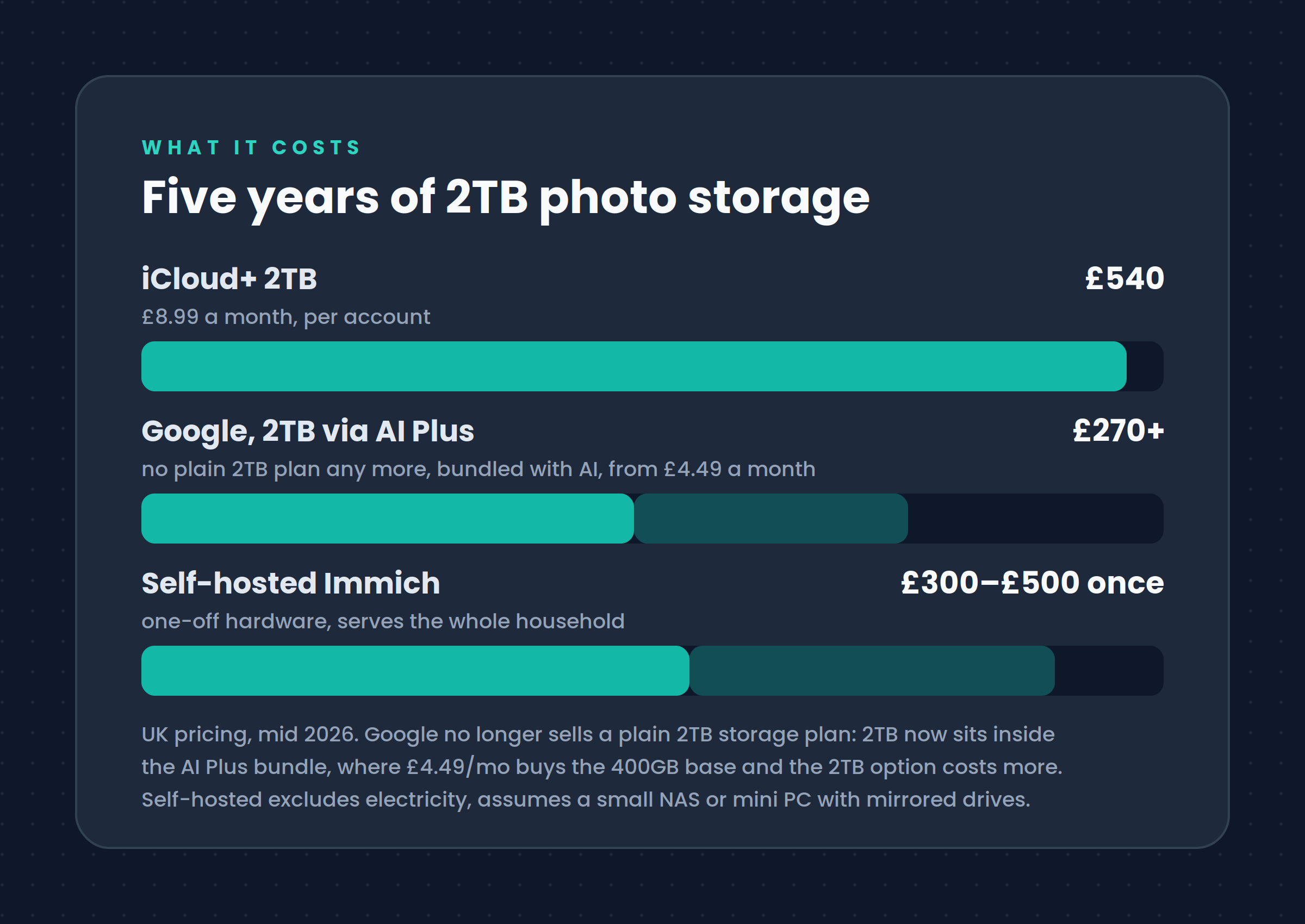
And then there is cost, which deserves real numbers. In the UK, iCloud+ charges £8.99 a month for 2TB, which is roughly £540 over five years, per account. Google has gone further and no longer sells a plain 2TB storage plan at all: standalone storage now tops out at 200GB for £1.59 a month, and 2TB only comes bundled inside a Google AI subscription. That is exactly the kind of drift we mean. The product you signed up for can be restructured underneath you, and the price of keeping your photos becomes the price of whatever else the provider wants to sell that year. Against that, a capable secondhand mini PC or small NAS with mirrored drives costs £300 to £500 once, serves the whole household rather than one account, and Immich itself is free. The hardware pays for itself within a few years, and everything after that is electricity.
The honest trade-offs
We wrote before about what a custom website really costs, and the same rule applies here: the honest version includes the downsides.
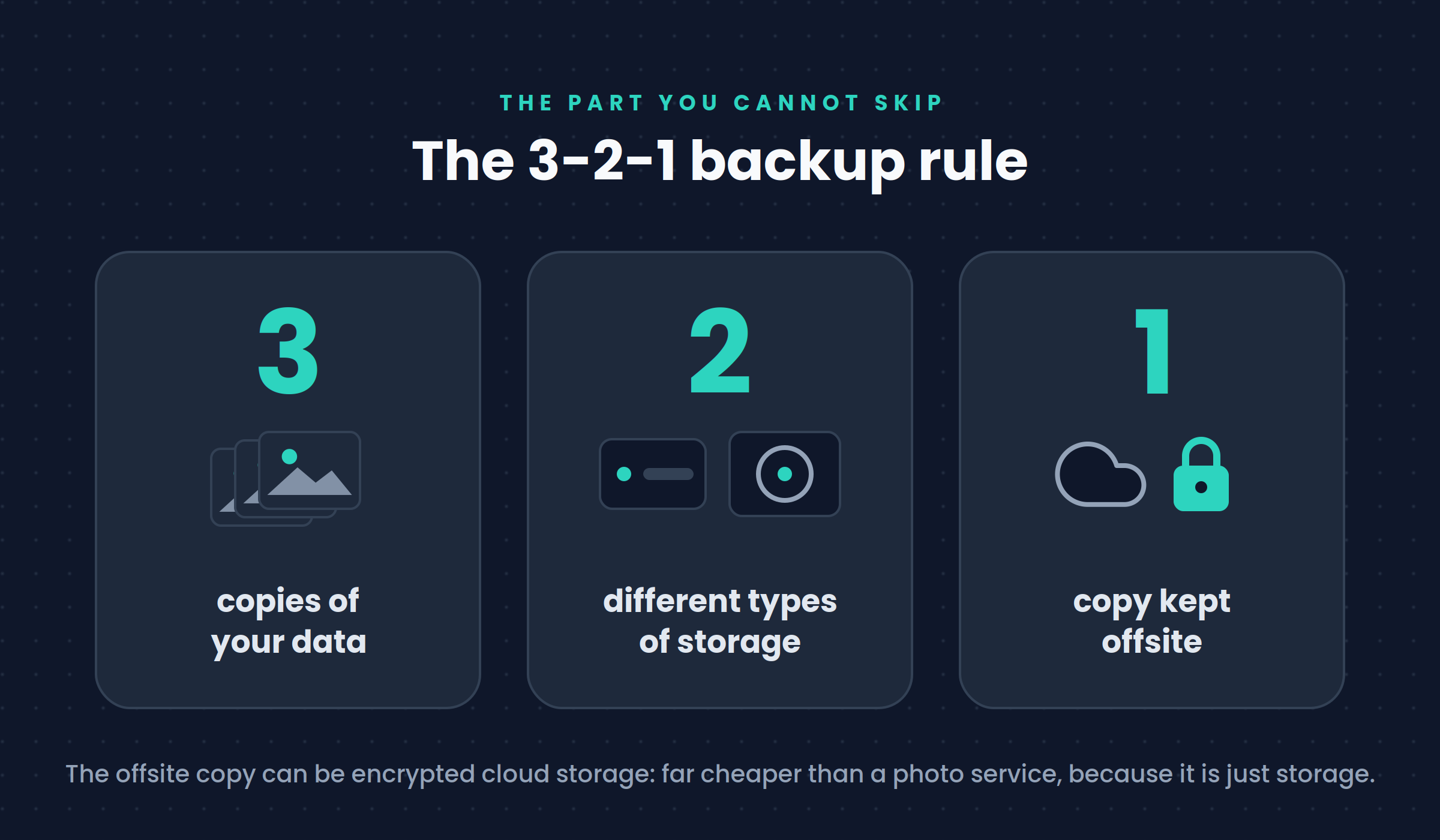
When you self-host, you are the sysadmin. Updates, disk health, and uptime are your responsibility. Backups stop being Google's problem and become yours, and this is the one part you cannot skip: a photo library on a single disk in your house is one power surge away from not existing. The standard answer is a 3-2-1 backup: three copies of your data, on two different types of storage, with one copy offsite. That offsite copy can itself be an encrypted cloud backup, which is much cheaper than a full photo service because it is just storage.
It is also worth saying that the big providers are genuinely good at the boring parts. Their redundancy is world-class, their uptime is better than anything you will run at home, and they require zero maintenance from you. If a hard drive fails in a Google data centre, you will never know it happened. If one fails in your cupboard, you will.
Who should switch, and who should not
Stay with the cloud if you never want to think about any of this. That is a completely legitimate position, and the monthly fee is what you are paying for the privilege.
Consider switching if you already run a NAS or a home server, or you are happy to rent a small VPS, and the ownership argument resonates. If you are the sort of person who backs things up anyway, Immich is close to a free upgrade.
And there is a sensible middle path: run Immich as your primary library, on your own hardware, with an automated encrypted backup to offsite storage. You get ownership, searchability, and control day to day, plus a safety net that does not depend on your cupboard.
Own your infrastructure
We run our own infrastructure at HelloMaiko, including the server this site is deployed on, so this is not theory to us. If you are a business or a household that wants to take ownership of your data, from photo libraries to file sync and media servers, take a look at our home lab and privacy solutions or get in touch and we will help you work out what makes sense.